A new era for radiometric data processing in Oasis montaj
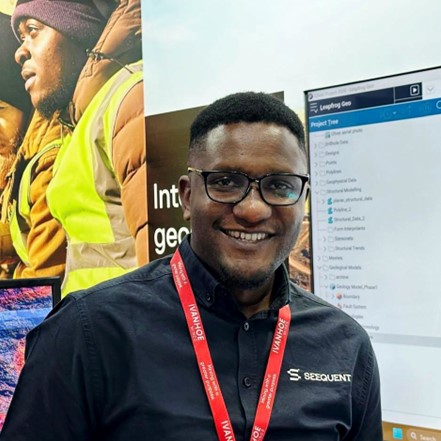
Victor Mapuranga
Geophysicist at Seequent
Victor is a geophysicist with a background in academia and working in the consulting space. He has experience across gravity, magnetics, ERT/IP, and seismic geophysical methods, and focuses on practical, field-informed approaches rather than theoretical complexity. Victor’s work at Seequent involves collaborating closely with Oasis montaj users across EMEA, learning from their challenges, sharing useful techniques, and improving workflows together. He values clarity, and continuous learning, and aims to make advanced tools more applicable for every geoscientist.
DATE:
12 October 2026
PARTICIPANTS:
Minimum: 4 | Maximum: 20
FEE:
Workshop Only Delegate: R3300
Workshop Conference Delegate: R2300
Student: R1150
TARGET AUDIENCE:
This workshop is ideal for geoscientists, geophysicists, and data processors seeking to improve confidence in radiometric workflows and interpretation reliability.
DURATION:
The session is a 1 Day Course
CPD POINTS:
CPD points awarded = 1
About This Event
This hands-on SAGA workshop introduces a modern, structured approach to radiometric data processing in Oasis montaj, aligned with IAEA best practices. Participants will follow a clear, end-to-end workflow that transforms raw spectral data into reliable, interpretation-ready products.
Developed through a collaboration between Seequent and Medusa Radiometrics, this next-generation workflow responds to the growing complexity of modern datasets. With today’s airborne and drone systems routinely capturing hundreds to thousands of spectral channels, traditional processing approaches have struggled to keep pace. This workshop demonstrates how a transparent, reproducible workflow enables geoscientists to confidently process and interpret high-resolution radiometric data.
Participants will work through the complete processing chain, from raw spectra to final outputs, with emphasis on:
- Preserving the full gamma-ray spectrum
- Applying corrections in the correct sequence
- Understanding how early processing decisions influence final results
- Maintaining transparency and traceability throughout
A key focus is on informed decision-making, ensuring participants can evaluate and justify each processing step rather than rely on black-box methods.
What I Will Learn
By the end of this workshop, participants will develop practical expertise in radiometric data processing and the ability to confidently apply a structured workflow from raw data to final interpretation products.
By the end of the workshop, participants will have practical skills to apply a structured radiometric workflow with confidence:
1. End-to-End Workflow Understanding
Understand the full radiometric processing pipeline and how each stage impacts data quality and interpretation.
2. Data Preparation and Quality Control
Import, validate, and inspect spectral datasets to identify acquisition issues early.
3. Spectral Smoothing (NASVD)
Apply Noise-Adjusted Singular Value Decomposition (NASVD) to reduce noise while preserving signal, using eigenvalue analysis to guide data-driven decisions.
4. Radioelement Extraction
Define energy windows for K, U, Th, and total counts, and understand how spectral quality affects accuracy.
5. Filtering and Stabilisation
Apply controlled filtering to stabilise radiometric channels within the workflow.
6. Radiometric Corrections
Apply key corrections in the correct sequence, including:
- Background (aircraft and cosmic)
- Atmospheric radon
- Altitude correction
- Dead time correction
- Compton stripping
7. Final Products and Interpretation
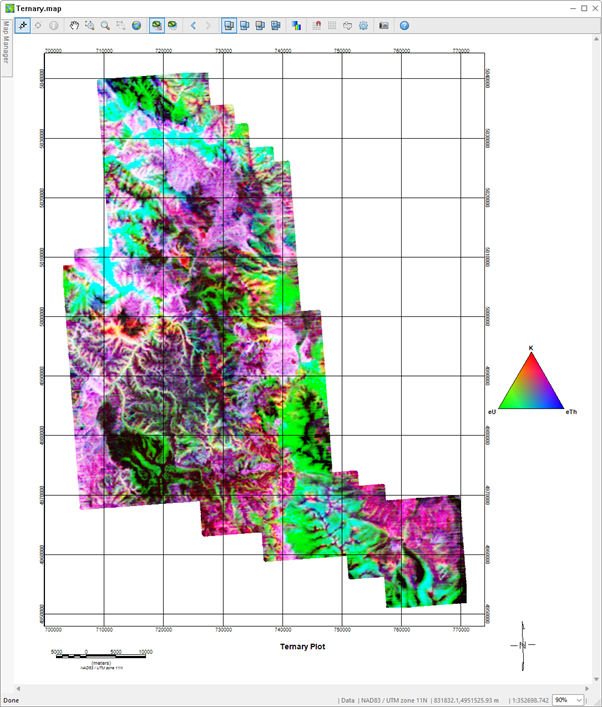
Generate concentrations (%K, eU, eTh), ratio maps, and ternary images, and link results back to processing decisions.
8. Continuous Quality Control
Use QC as a diagnostic tool to identify and resolve issues throughout the workflow.
9. Traceable Outputs
Produce fully traceable, reproducible datasets suitable for interpretation, reporting, and reprocessing.
What Should I Bring
- A laptop that meets Oasis montaj system requirements:
https://www.seequent.com/help-support/system-requirements/oasis-montaj-and-target/
Seequent will provide:
- Temporary training licenses for the duration of the workshop
- Radiometric datasets and guided exercises
Prerequisites Required
Basic familiarity with Oasis montaj (recommended but not required)